
Why maths shapes work better in the hand
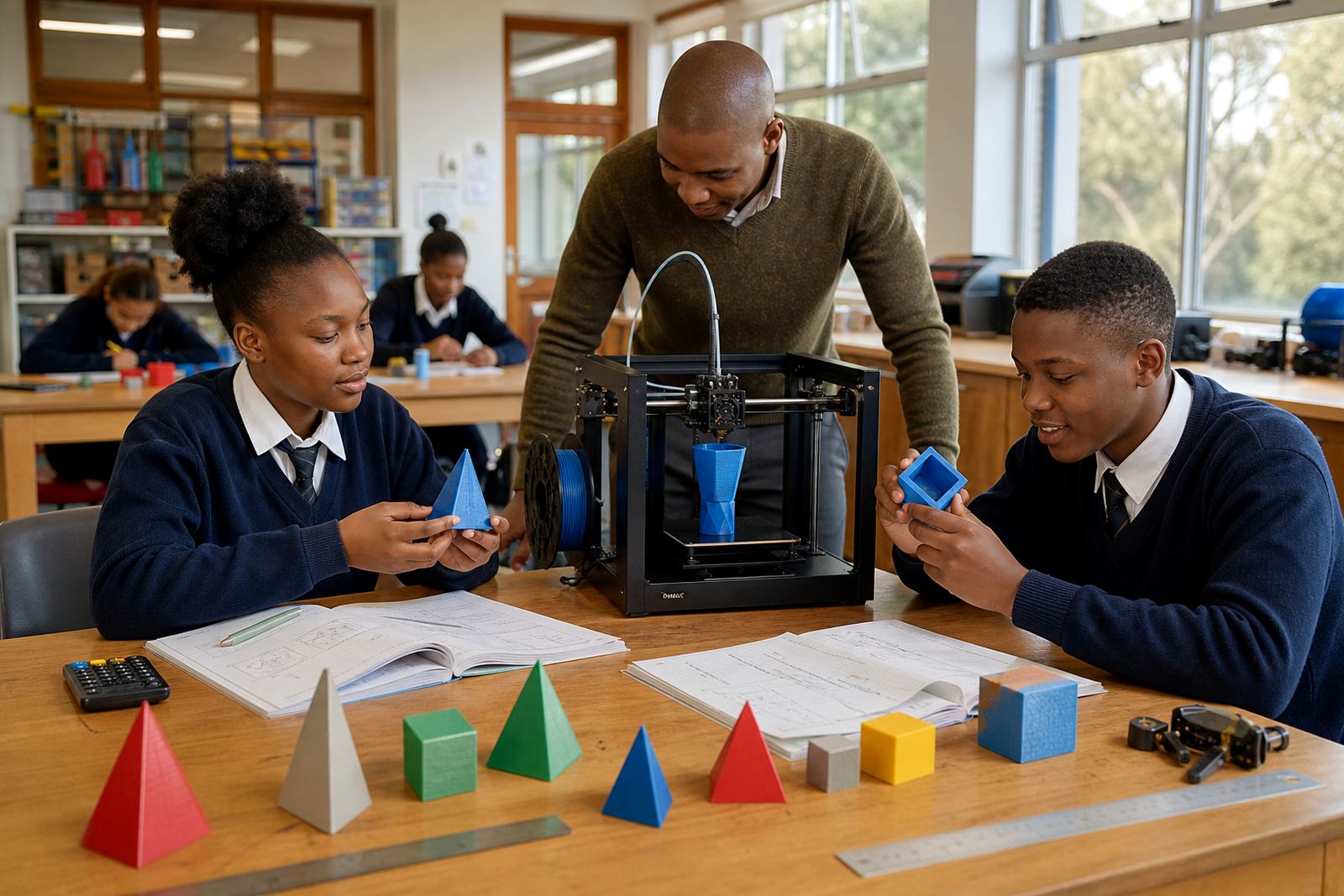
Many learners understand shape concepts faster when they can compare faces, edges, corners and symmetry with real objects. A printed solid gives a clear reference for counting vertices, checking nets, and measuring height, width and depth in a way that learners can touch and rotate.
This is useful in Grade 4 to Grade 9 classes, but it also helps in remedial support and enrichment groups. Teachers can move from basic naming of 2D and 3D forms to real classroom tasks like estimating volume, matching nets to solids and comparing scale. In windy coastal areas or during load-shedding, having physical models ready on a shelf means the lesson can still go ahead even if the projector or internet is not available.
- Use solids for quick sorting tasks by faces, edges and curved surfaces
- Use matching sets for pair work, group challenges and revision stations
- Use larger prints for board demonstrations and smaller sets for each table
Typical equipment set for a maths shapes corner
A solid maths set does not need to be complicated. Most schools start with a mix of common geometric forms, a few classroom tools and a safe storage system. The aim is to keep the setup practical, easy to issue and simple to clean after a lesson.
For a standard classroom set, the equipment usually includes printed solids, labelled storage tubs, rulers, calipers for older learners, a cutting mat for checking nets, and a small printer station for making replacements. Some schools also add blank template cards, shape charts and a tray for unfinished models. In Stellenbosch, Paarl and Somerset West, many teachers prefer compact storage because space is often shared between subjects.
- Basic shapes: cube, cuboid, cylinder, cone, sphere, triangular prism and square pyramid
- Measurement tools: ruler, tape measure, simple callipers and angle guide
- Support items: storage tray, labels, spare filament, cleaning brush and safety goggles
How to plan the classroom layout
A good layout keeps movement clear and the equipment close to where learners use it. One table can be set aside for demonstration, one for group work and one for printer handling. If the class is large, use a simple rotation system so only a few learners handle the printer at a time while the rest work on calculations, sketches or net matching.
Place the printer on a stable surface away from heavy foot traffic, open windows and moisture. This matters in Durban, Gqeberha and other coastal areas where humidity can affect material storage. Keep the filament sealed when not in use and make sure learners know not to touch heated parts. A small sign with class rules helps a lot and can save time during busy periods.
- Keep a clear path between the printer, teacher table and learner work tables
- Store small parts in labelled containers so pieces do not go missing
- Use a lockable cupboard for consumables, tools and unfinished prints
Common mistakes schools should avoid
The most common problem is starting with too many models and not enough lesson structure. If the class only handles objects without a clear task, the activity becomes a toy exercise instead of a maths lesson. Another mistake is printing delicate parts that break after a few uses, which wastes time and budget.
Schools also sometimes forget that different age groups need different scale. A model that works for a small group may be too tiny for a whole class demonstration. Another issue is skipping maintenance, which leads to blocked nozzles, uneven layers or poor prints. A quick end-of-day check, especially before weekends or public holidays, helps keep the equipment ready. Teachers should also avoid putting the printer next to a heater, kettle or direct sun through the window.
- Do not rely on one set of models for every grade
- Do not store filament loosely in humid rooms
- Do not allow learners to handle moving parts during printing
Budget ranges for maths shapes setups
Budgets vary depending on how many learners must use the set, whether the school wants one printer or more than one, and how much teacher support is needed. A small starter setup for a single classroom can begin with a modest spend, while a full school lab kit for multiple grades needs a bigger allocation. Schools often plan in stages so they can start with the essentials and add more solids later.
For South African schools, a simple classroom kit with printed solids, tools and storage can sit in the lower budget range, while a guided lab setup with training and maintenance support moves into a higher range. Planning also needs to include ongoing consumables like filament, replacement parts and the occasional reprint of lost or damaged pieces. If the printer will be used daily, it is wise to keep a small reserve for repairs.
- Entry classroom maths set: about R3 500 to R9 500
- Mid-size teacher and learner kit: about R10 000 to R28 000
- Full lab setup with training and support: about R30 000 to R85 000
Training options that support maths teaching
Schools usually get the best results when teachers understand both the subject goal and the equipment. Our training options can cover teacher introduction, printer operations, project planning, lab setup and maintenance basics. For maths shapes use, the focus is on lesson flow, model choice and how to turn a printed object into a counting, measuring or reasoning activity.
We work with schools in Cape Town, Johannesburg, Pretoria, Durban, Gqeberha, Paarl and Somerset West, as well as Stellenbosch and surrounding areas. The training can be adapted for a staff meeting, a holiday programme or a small group workshop. If the school has a busy timetable, a short management briefing can help decision makers plan the rollout before the first class begins.
- Teacher Introduction for staff new to 3D printing
- Learner Foundations for basic classroom use
- Custom Group Workshop for maths departments and lab teams