
Holiday workshops for learners and teachers
Our Holiday Programme is set up for schools, holiday clubs and small groups that want a focused introduction to 3D printing without a long-term training commitment. Sessions are practical from the start. Learners are guided through basic design thinking, simple modelling ideas, printer setup, filament handling and safe classroom habits that work well in South African school settings.
The content is suitable for beginners, with enough flexibility to include older primary learners, high school groups and teachers who want to explore how 3D printing can fit into STEM, design or maker activities. We keep the pace steady so participants can work through each step and leave with a finished item or a clear next project to continue later.
- Short-format sessions for school holidays or compact workshop days
- Introductory creative tasks with practical print outcomes
- Teacher-friendly guidance for classroom follow-up
- Suitable for small groups, clubs and holiday enrichment programmes
What is covered during the programme
Holiday Programme sessions can be shaped around the age group, the available time and the equipment on site. A standard session usually includes a basic introduction to how a 3D printer works, the main parts of the machine, and the difference between design time, slicing time and print time. We also cover sensible classroom rules such as keeping hands clear of moving parts, letting the nozzle cool before handling and storing filament away from dust and moisture.
For groups that want more design work, the session can include CAD basics using simple shapes, measurements in millimetres and a first project that is realistic for a school timetable. Where the focus is on printing, we can spend more time on bed levelling, loading filament, starting a job and checking print quality. Schools in coastal areas such as Cape Town, Gqeberha and Durban often benefit from a short discussion on humidity, filament storage and how to keep equipment in working order over the holidays.
- Basic 3D printer parts and operation
- Simple design concepts and measurements
- Filament handling and storage
- Print preparation, starting and monitoring
- Classroom safety reminders and clean-up habits
Typical session structure and turnaround
The Holiday Programme is planned in advance so schools know exactly what will happen on the day. Once an enquiry comes in through the contact page, we confirm the group size, age range, location and whether equipment is already available on site. From there, we suggest a session structure that suits the school holiday timetable. Most bookings are arranged as a half-day or a full-day workshop, although shorter introductory sessions can also be prepared.
Before the session, we confirm the learner numbers, the space available and any power supply concerns, especially where load-shedding may affect longer print demonstrations. We then prepare the teaching flow and the materials needed for the workshop. If a school already has printers, we can build the session around that setup. If not, we can provide guidance on the type of equipment and consumables needed for a practical holiday workshop.
- Enquiry and group details received through the contact form
- Session outline confirmed for age group and duration
- Materials and equipment requirements agreed
- Workshop delivered on the arranged date
- Follow-up guidance provided for the next step
School equipment and classroom setup
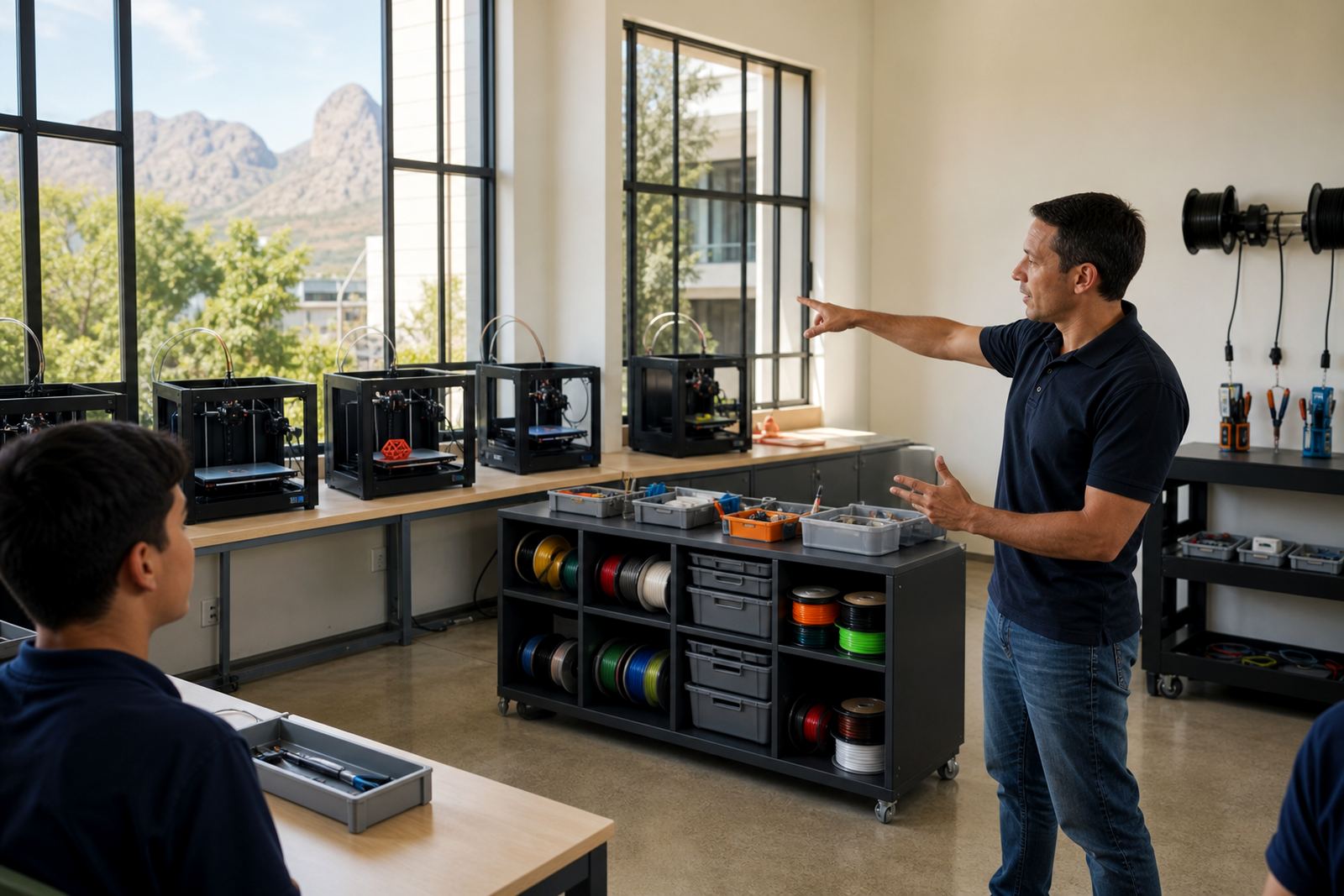
For schools that want to run holiday sessions on their own premises, we can supply classroom-friendly lab kits that support a small 3D-printing environment. These are designed for practical education use and are kept simple enough for teacher supervision. A typical setup can include a printer, starter filament, basic tools, a cooling or storage area, and printed guides that help learners follow the process without crowding the machine.
We advise on placing equipment in a clean indoor room with good airflow, a stable table, access to power and enough space around the printer for supervision. In municipal buildings and school halls, it is also worth checking any local safety requirements before installation, especially where extraction, noise or access control may matter. For schools near the coast, we often recommend keeping spare filament in sealed containers and wiping down metal parts regularly to reduce moisture related issues.
- Starter printer setup for supervised classroom use
- Tools and accessories for basic operation
- Filament storage advice for humid areas
- Simple print area layout and supervision tips
Programme options for different holiday groups
Not every school holiday group needs the same format, so the Holiday Programme can be adjusted to suit the intended outcome. Some schools want a lively creative workshop with a few finished models at the end. Others want a more technical introduction where teachers and learners see how design choices affect print quality. We can also arrange sessions that combine both approaches, which works well for mixed-age groups and holiday clubs with limited time.
Common options include maker-style activities for learners, teacher support sessions that build confidence with the basics, and project-based workshops where each participant takes home a simple printed item. If the school wants a stronger classroom link, we can shape the session around subjects like geometry, design, entrepreneurship or problem solving. This makes it easier for educators to carry the ideas into term time once the holidays are over.
- Learner-focused creative workshops
- Teacher support and confidence-building sessions
- Mixed-age groups with simple project outcomes
- Subject-linked activities for classroom follow-up
Pricing approach and ongoing maintenance intervals
Pricing for the Holiday Programme depends on the session length, the number of participants, the travel distance and whether equipment, consumables or printed materials are needed. We quote according to the actual workshop requirements rather than using a one-size-fits-all rate. That keeps the costs practical for schools and helps each booking reflect the real level of preparation involved.
If a school is running its own printer during the holidays, we also suggest a simple maintenance rhythm. Before the session, check belts, the build surface and filament path. During longer holiday periods, wipe dust from the machine, store filament properly and run a test print before the next group arrives. Monthly checks are usually enough for light use, while busier school labs may need more regular cleaning and nozzle inspection. If a printer is used across multiple holiday sessions, a quick inspection after each workshop is a sensible habit.
- Pricing based on group size, duration and materials
- Travel and venue details considered in the quote
- Pre-session machine check recommended
- After-session cleaning and storage routine
- Monthly or termly maintenance depending on use
Key facts
| Format | Short-format holiday workshop for learners and educators |
|---|---|
| Typical duration | Half-day or full-day sessions, with shorter options on request |
| Group size | Small to medium school groups, depending on room and equipment |
| Core topics | 3D printer basics, CAD basics, print prep, safe use and project planning |
| Equipment support | School lab kit guidance, starter tools and filament storage advice |
| Maintenance interval | Quick check before each session, cleaning after use, deeper inspection monthly or termly |