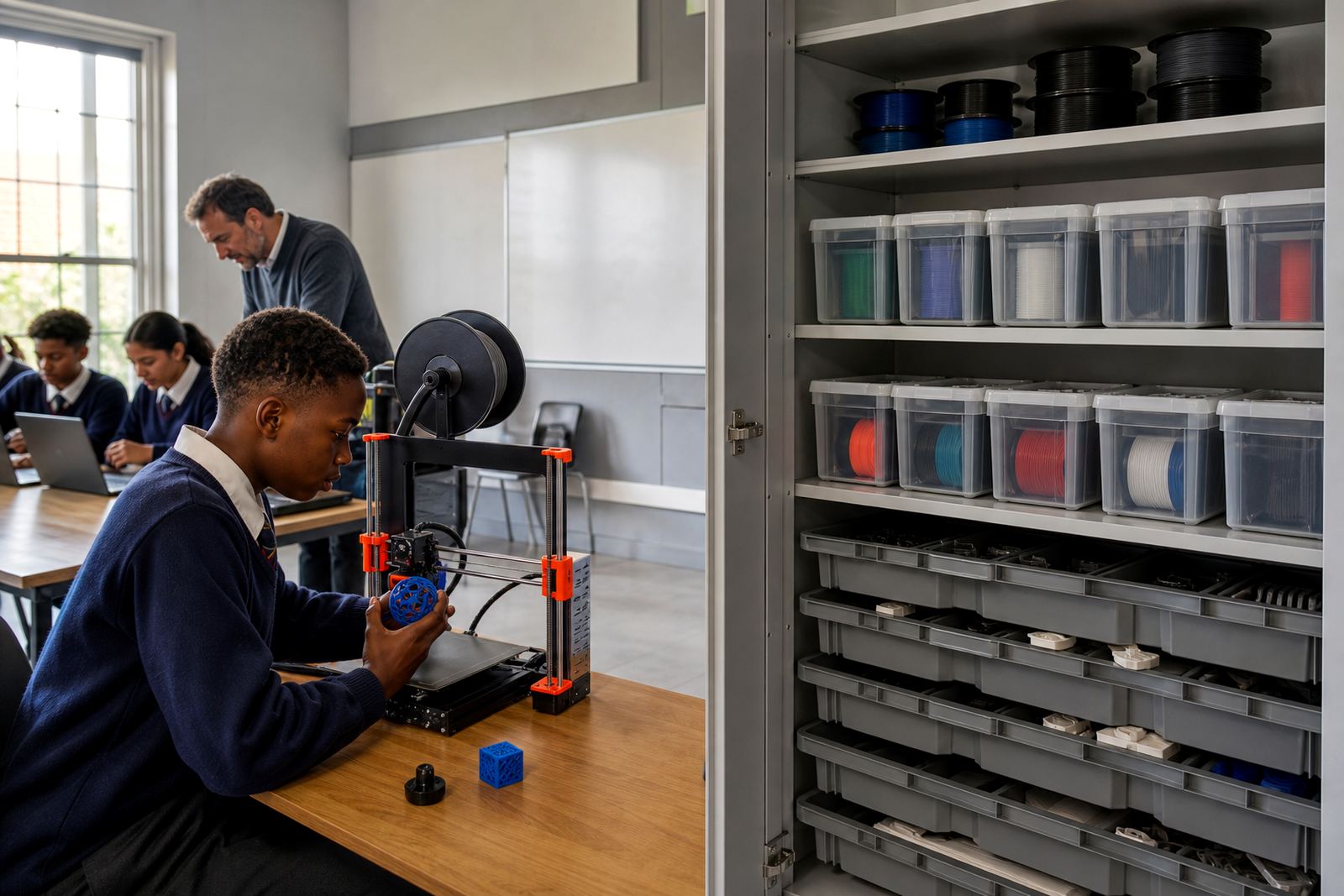
What the Storage Lab Pack is for
The Storage Lab Pack is a practical classroom storage solution for schools that run 3D printing and related project work. It brings together shelving, sealed tubs, labelled containers and output storage so teachers and learners can find what they need without wasting time hunting through cupboards or open boxes.
It is especially useful where several classes share the same room, or where one teacher manages a lab with changing groups during the week. Materials stay grouped by job, tools stay in their place, and completed models do not get damaged or mixed up with fresh work. In South African schools where space is often tight and rooms may double up for other subjects, that kind of order makes a big difference.
Standard layout and storage options
The pack is built as a modular storage system, so it can be arranged to suit a small classroom corner or a fuller lab with multiple printers and teaching stations. Typical components include open shelving, stackable storage bins, sealed material boxes, project trays and a designated shelf or crate system for student outputs.
Depending on the room and the amount of stock you keep on site, the pack can be set up in a compact format or expanded with extra containers. Schools often use it for filament reels, cutting tools, nozzles, build plates, sample models, glue, calipers, spare fasteners and class sets of small project parts. Where humidity is a concern, especially in coastal towns, the sealed storage helps keep moisture away from materials that need to remain dry.
- Open shelving for frequently used items
- Closed bins for dust-sensitive materials
- Labelled trays for learner projects
- Dedicated storage for tools and consumables
- Optional lockable sections for controlled access
Where it suits in a school environment
This pack works well in technology classrooms, STEM labs, media centres, library innovation spaces and after-school maker clubs. It is also a good fit for schools that run holiday programmes or teacher training sessions and need a clear way to separate demo items from learner stock.
In larger campuses, the Storage Lab Pack can support one central store room or several smaller teaching areas. A school in Stellenbosch may use it for a single lab, while a larger site in Johannesburg or Pretoria may spread the storage across more than one room. It also helps when rooms are shared with other subjects, because items can be packed away safely after the lesson and brought back out in a planned way.
- Suitable for classrooms with shared access
- Useful for small labs with limited cupboard space
- Works for teacher prep rooms and store rooms
- Supports regular class rotation and project handover
Installation, space and power needs
Installation is straightforward and normally only needs a level floor, enough wall or floor space for the shelving, and clear access for teachers and support staff. The pack itself does not require gas. Power is only needed if you are placing the storage close to printers, dehumidifiers or other equipment that uses electricity. If the room is affected by load-shedding, the storage should be positioned so that teachers can still access tools and materials safely without having to move through a dark or crowded area.
As a guide, a compact setup suits a small room, while a larger lab may need a full wall run plus a central storage point. It helps to keep the storage away from direct sunlight, leaking windows and damp exterior walls. In older school buildings, especially where the floor may be uneven, a quick site check before installation saves time later and prevents shelves from rocking or bins from slipping.
- Level floor surface recommended
- Allow clear walking space between shelves and printer stations
- Keep away from water leaks, heat sources and open windows
- No gas connection required
- Electrical supply only needed for any separate equipment nearby
Keeping materials tidy and easy to track
Good storage is not only about neatness, it also helps with stock control. When each item has a set place, teachers can see what is missing, what needs topping up and what should be returned after a lesson. That makes it easier to keep a class moving, especially when several learners are sharing tools or finishing different parts of the same project.
The Storage Lab Pack is useful for separating raw material from finished work. Student models can be placed in labelled trays or crates by class group, which cuts down on breakages and confusion. It also reduces the chances of small parts going missing, which is a common problem in busy rooms. A simple label system and end-of-day packing routine will keep the space working properly through the term.
- Label bins by material, class or task
- Return tools to the same place after each lesson
- Store completed prints in a separate tray or crate
- Keep fast-moving items near the front for easy issue
Care, cleaning and regular servicing
The pack needs only basic care. Wipe shelves and containers with a dry or lightly damp cloth, and keep dust from building up around corners and labels. If the room is coastal or carries fine workshop dust, a regular clean keeps lids closing properly and stops grit from getting into small parts. Avoid overloading shelves, because too much weight in one section can cause sagging over time.
A simple monthly check is usually enough for most schools. Look for cracked bins, loose labels, worn hinges on lockable sections and any shelving that has shifted after use. If the room is used by many classes, it helps to assign one staff member to do a quick stock count and tidy-up at the end of the week. Nothing fancy, just steady upkeep so the system stays useful.
- Clean surfaces regularly to remove dust and debris
- Check shelves for weight and stability
- Replace damaged bins or faded labels quickly
- Keep storage dry and well ventilated
What to check before placing an order
Before ordering, it helps to know the room size, the number of learners using the space and what will be stored. Some schools need mostly filament and tool storage, while others want space for printed projects, teaching kits and maintenance items as well. The more clearly the storage is planned, the better it will fit the way the room is used each day.
Also check whether the pack must fit through narrow doors, fit beside printers or sit against a wall with limited depth. If the school has different age groups using the same room, ask for a layout that separates learner access from teacher-only items. For schools in Cape Town, Durban, Gqeberha and other busy centres, this kind of practical planning helps avoid clutter and keeps the lab running smoothly through a full term.
- Measure available floor and wall space
- List the materials and tools that need storage
- Check whether you need lockable sections
- Confirm access for delivery and placement
- Plan for future growth if more classes will join later
Key facts
| Product type | Classroom and lab storage package for 3D printing materials, tools and learner outputs |
|---|---|
| Typical use | Schools, makerspaces, tech rooms, teacher prep areas and holiday programme spaces |
| Configuration | Modular shelving, stackable bins, sealed storage boxes, project trays and tool grouping |
| Room needs | Level floor, clear access, dry area and enough space for shelving plus movement |
| Power or gas | No gas required; power only needed for separate nearby equipment such as printers or dehumidifiers |
| Maintenance | Routine dusting, label checks, bin inspection and regular stock control |